
How Custom Sports Medals Are Designed From Concept to Finished Product
14/08/2026Custom sports medals are more than presentation pieces. They capture the identity of an event, celebrate achievement and give recipients something tangible to remember long after the competition has ended.
From junior football and school athletics to swimming carnivals, fun runs and national tournaments, a well-designed medal can make an event feel more professional and memorable. But how does an initial idea become a finished medal ready for presentation?
This guide explains the custom sports medal design process, from developing the concept and choosing materials to approving the artwork and adding the final presentation touches.
Why Choose Custom Sports Medals?
Standard medals are practical for many presentations, but custom medals allow organisers to create something unique to their event, club or organisation.
A customised medal may incorporate:
- A club or association logo
- The name of the competition
- A sporting symbol or activity
- A local landmark or regional theme
- The year or event date
- Sponsor branding
- A special shape or border
- Custom ribbon colours
- First, second and third-place details
These elements transform an ordinary award into a meaningful keepsake. If you are planning an event in Victoria, Pakenham Trophies can help you explore medal and award options for different sports, budgets and presentation requirements.
Step 1: Defining the Purpose of the Medal
Every successful custom medal begins with a clear brief. Before developing the design, determine what the medal needs to represent and who will receive it.
Important questions include:
- What sport or activity is being recognised?
- Is the medal for winners, place-getters or all participants?
- Is it for a one-day event or an annual competition?
- How many medals are required?
- What is the available budget?
- When is the presentation date?
- Will different divisions require different versions?
- Should the medal match existing club branding?
A junior participation medal may need to be colourful and energetic, while a championship medal might require a more prestigious gold, silver or antique-metal finish.
Understanding the purpose from the beginning makes it easier to select the appropriate size, shape, material and production method.
Step 2: Gathering Ideas and Brand Elements
The next stage involves collecting the visual elements that will inspire the medal design. Organisers may provide a club logo, event artwork, colour palette, mascot or examples of previous awards.
Useful design materials include:
- High-resolution club or event logos
- Vector artwork where available
- Brand colour references
- Sponsor logos
- Event slogans
- Relevant sporting imagery
- Examples of preferred medal styles
- Correct competition wording
A local sporting event could also incorporate a recognisable landmark or regional symbol. This can give the medal a stronger connection to the community and make it more distinctive.
When supplying artwork, clear files produce the best results. Low-resolution screenshots or images copied from social media may need to be recreated before they can be used in production.
Step 3: Choosing the Medal Style
Once the concept is clear, the medal style can be selected. The right choice will depend on the event, required quantity, design complexity and budget.
Classic Sports Medals
Traditional round medals are versatile and suitable for almost every sport. They can feature a standard sporting image, personalised centre insert or engraved details.
These are popular for:
- Football and AFL
- Netball
- Basketball
- Soccer
- Cricket
- Swimming
- Athletics
- Martial arts
- Dance competitions
- School sports
You can browse available trophies, medals and awards online to compare different styles for your presentation.
Custom-Shaped Medals
Custom-shaped medals follow the outline of a logo, mascot, sporting item or event symbol. Examples might include a football, shield, running shoe, bicycle or local landmark.
An unusual shape helps an event stand out and can make the medal more attractive to participants and collectors.
Printed or Insert Medals
Printed inserts are a practical way to add full-colour artwork to a medal. They can display detailed logos, gradients and multiple colours that may be difficult to reproduce using traditional metal finishes.
This option can work well for schools, local clubs and community events seeking branded medals without requiring a fully custom metal mould.
Die-Cast Medals
Die-cast medals are manufactured using a custom mould. They can include raised and recessed details, cut-out areas, textured backgrounds and unique shapes.
This production method is often chosen for larger events, championships, fun runs and annual competitions that want a completely original medal.
Step 4: Selecting the Size and Shape
Medal size affects both visual impact and cost. A larger medal provides more room for detailed artwork and wording, while a smaller design may be more suitable for junior events or high-volume participation programs.
Common shapes include:
- Round
- Oval
- Shield
- Star
- Rectangular
- Sporting equipment shapes
- Logo-shaped outlines
- Fully customised silhouettes
The design should remain clear at the finished size. Too much text or fine detail can make a small medal look crowded, so simplifying the artwork often creates a stronger result.
Step 5: Choosing Colours and Metal Finishes
The finish has a major influence on the appearance of a custom sports medal. Popular options include:
- Polished gold
- Polished silver
- Bronze
- Antique gold
- Antique silver
- Antique bronze
- Black or dark metal
- Full-colour enamel
- Soft enamel detailing
Gold, silver and bronze are ideal when medals need to identify first, second and third place. An antique finish can highlight raised details and give the medal a traditional or prestigious appearance.
Colour can then be added to match the club logo, event theme or sponsor branding. It is usually best to use a controlled colour palette rather than placing too many competing colours into one small design.
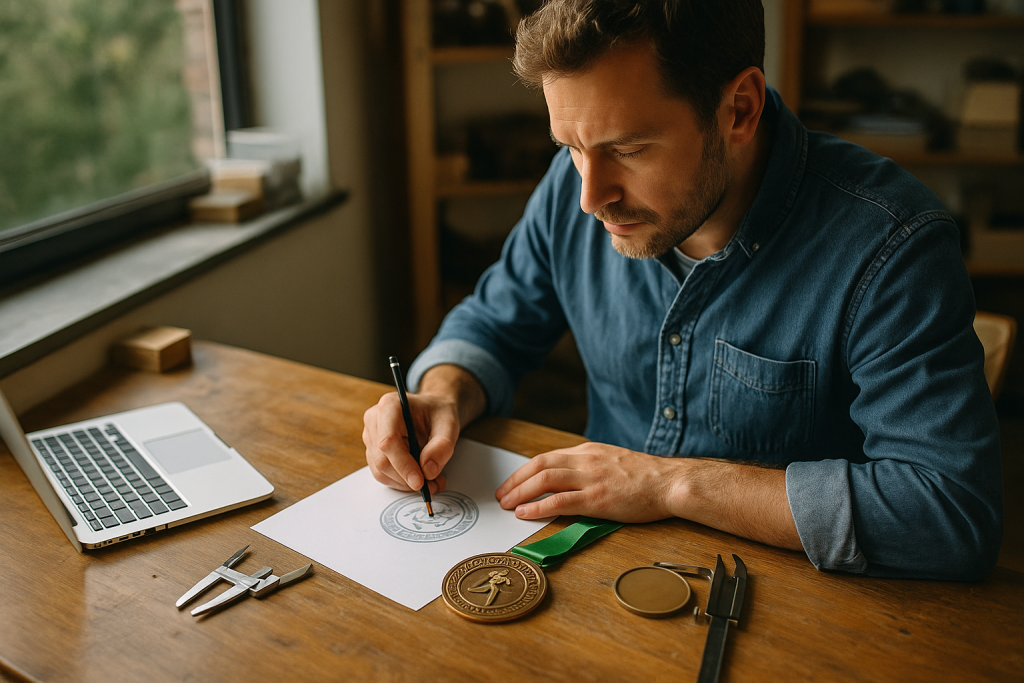
Step 6: Developing the Medal Artwork
After the specifications have been confirmed, the initial concept is converted into production-ready artwork.
The layout may include:
- Event name
- Club or association logo
- Sporting imagery
- Award category
- Year
- Decorative borders
- Sponsor recognition
- Raised or recessed areas
- Enamel colour placement
During this stage, the designer considers how the artwork will appear when manufactured—not just how it looks on a computer screen. Fine lines may need to be thickened, text may need to be enlarged and complex details may need to be simplified.
The strongest medal designs usually have one clear focal point, readable wording and enough open space to prevent the finished piece from feeling cluttered.
Step 7: Reviewing and Approving the Design
Before production begins, organisers should carefully review the artwork proof.
Check the following details:
- Spelling of the event and organisation name
- Competition year
- Award categories
- Logo accuracy
- Sponsor names
- Medal dimensions
- Metal finish
- Enamel colours
- Ribbon style
- Engraving requirements
- Required quantity
It is particularly important to check dates and spelling before providing final approval. Changes can be straightforward during the artwork stage but may be difficult or costly once manufacturing has started.
Where several committee members are involved, nominate one person to collect feedback and approve the final design. This can prevent conflicting instructions and unnecessary delays.
Step 8: Manufacturing the Medals
Once the artwork is approved, the design moves into production. The exact manufacturing process depends on the chosen medal type.
For fully custom medals, production may involve:
- Creating a mould from the approved design
- Casting or stamping the medal
- Trimming and polishing the edges
- Applying the chosen metal plating
- Adding enamel colours or printed details
- Inspecting the medal for quality
- Attaching the selected ribbon
Production time can vary according to the complexity, quantity and manufacturing method. Organisers should begin planning well before the event date, particularly when ordering custom-made medals in larger quantities.
Step 9: Adding Personalised Engraving
Engraving can make each medal more personal. Depending on the medal design, information may be engraved directly onto the back or added to an engraving plate.
Popular engraving details include:
- Recipient’s name
- Finishing position
- Age division
- Team name
- Event date
- Competition category
- Personal best result
For example:
Pakenham Junior Athletics
Under 12 – First Place
2026
If individual names are required, provide the final recipient list in a clear spreadsheet. Check spelling carefully and keep the formatting consistent across every category.
Step 10: Selecting the Ribbon
The ribbon is an important part of the overall medal design. A well-chosen ribbon can reinforce an event’s branding and make the finished medal feel more complete.
Options may include:
- Single-colour ribbons
- Two-colour ribbons
- Club-colour combinations
- Red, white and blue place ribbons
- Printed event ribbons
- Branded ribbons featuring a logo or event name
For first, second and third place, organisers may use different ribbon colours or keep the same ribbon and distinguish each placing through the medal finish.
Step 11: Quality Checking and Presentation
Before the awards are distributed, inspect the completed medals and organise them by category.
Check that:
- The correct quantities have been supplied
- Medal finishes match the approved order
- Ribbons are securely attached
- Engraving is accurate
- Colours and logos appear correctly
- Medals are allocated to the correct divisions
Presentation boxes, pouches or display cases can be added for major awards. Participation medals may be arranged on presentation tables or grouped by division to make distribution easier.
How Early Should Custom Sports Medals Be Ordered?
Custom designs require more preparation than standard medals, so early planning is recommended. The design, artwork approval, production, delivery and engraving stages all need to be completed before the presentation date.
When requesting a quote, provide:
- The event date
- Required quantity
- Preferred medal size
- Logo or artwork
- Design ideas
- Required colours
- Ribbon preferences
- Engraving details
- Available budget
Starting early also gives your committee more time to review samples, confirm recipient information and make adjustments before production.
Custom Sports Medals for Australian Events
Custom medals can be created for many sporting and community occasions, including:
- Junior and senior club presentations
- School athletics and swimming carnivals
- AFL and football competitions
- Soccer and futsal tournaments
- Netball and basketball events
- Cricket competitions
- Running and cycling events
- Martial arts tournaments
- Dance and gymnastics competitions
- Charity challenges
- Corporate sporting events
- Regional championships
Whether you require a small number of medals for a local competition or a coordinated award package for a large presentation, the design should reflect the character and importance of the event.
Create Memorable Sports Medals with Pakenham Trophies
Pakenham Trophies provides trophies, medals and personalised awards for sporting clubs, schools, businesses and community organisations in Pakenham and throughout Victoria.
The team can help you choose a suitable medal style, coordinate colours and ribbons, prepare engraving and create an award package that suits your event and budget.
Visit Pakenham Trophies online to explore the available range, or visit the showroom at Shop 3/32 Treloar Lane, Pakenham, VIC 3810, Australia.
Ready to start planning your medals? Contact Pakenham Trophies to discuss your concept, quantities, artwork and presentation date.