
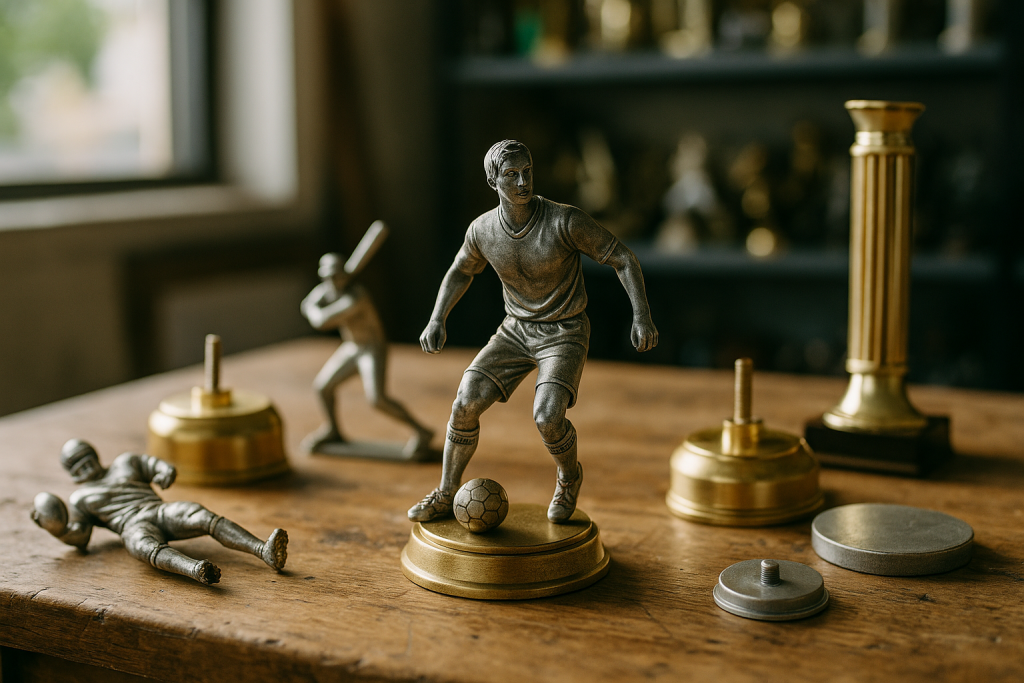
Custom Sports Figurines and Components for Unique Trophy Designs
21/08/2026Custom sports figurines and trophy components allow clubs, schools and competition organisers to create awards that reflect a particular sport, achievement and organisation. By selecting a suitable figure, base, column, insert, logo and engraving plate, you can develop a coordinated trophy design without every award looking identical.
This component-based approach is useful when you need trophies for several divisions, different levels of achievement or a full presentation night. The main design can remain consistent while individual details—such as the sport, award title, recipient or trophy height—change.
A successful design is not simply the one with the most decorative pieces. It should suit the occasion, clearly communicate what the recipient achieved and remain practical for the quantity, budget and presentation setting.
What Are Trophy Figurines and Components?
A sports figurine is the feature that visually represents an activity or achievement. It might depict a player, sporting action, ball, boot, racquet or a more general symbol of victory.
The other components create the trophy’s overall structure and appearance. Depending on the selected design, these may include:
- A trophy base
- Columns or risers
- Decorative trims
- Cups or holders
- Sport-themed inserts
- Logo centres
- Engraving plates
- Shields or emblems
- Figurines or achievement symbols
These elements can be combined in different ways. For example, the same base and column style might be used across an entire club range, while the top figure and engraving change for football, netball, cricket or basketball teams.
The result is a family of awards that looks coordinated on the presentation table but still recognises each recipient appropriately.
Why Use a Component-Based Trophy Design?
It creates a consistent club presentation
When trophies for different teams are ordered separately without a shared plan, the finished presentation can look disconnected. One team may have traditional gold trophies, another may have modern resin awards, and another may receive a completely different style.
Choosing a core combination of bases, colours and design details gives the full presentation a more consistent appearance. Variations can then be introduced for age groups, divisions and major awards.
It allows meaningful differences between awards
Not every achievement needs the same trophy. Component-based designs make it easier to establish a clear hierarchy.
A club might use:
- A smaller version for participation or team recognition
- A mid-sized version for coaches’ or managers’ awards
- A larger version for best-and-fairest or club champion
- A distinctive figurine for goalkeeping, umpiring or another specialist role
- A separate style for service and volunteer recognition
The designs remain connected, but the most significant awards can still stand apart.
It can represent the recipient’s sport
A sport-specific figure makes the award immediately recognisable. This is particularly useful for children’s sport, school competitions and multi-sport presentation events where several activities are being celebrated together.
For an organisation covering multiple sports, changing the figure or insert while retaining the same base and column style can provide consistency without losing relevance.
It provides room for club identity
The trophy does not have to rely entirely on the figurine to feel personal. Club colours, a business or school logo, the competition name and carefully written engraving can make an otherwise standard design specific to the organisation.
Pakenham Trophies can incorporate club and business logos into supplied awards and offers full-colour logo printing, laser engraving and CNC engraving.
Custom Does Not Always Mean Starting From Scratch
The word “custom” can describe different levels of personalisation.
A completely original, sculpted sports figure is one possibility, but it is not the only way to produce a distinctive trophy. Many organisations can achieve the look they want by combining existing components with custom engraving, branded artwork and a considered selection of colours and sizes.
Common approaches include:
Personalised standard design
An existing sports trophy is personalised with the recipient’s name, award title, team and season. A club logo may also be added where the selected product allows.
Modified component design
Different bases, columns, trims, figures or inserts are combined to create a design suited to the organisation. The main structure can be repeated across several awards.
Coordinated trophy range
One visual theme is used for an entire presentation, with different sizes or details indicating the importance of each award.
In-house manufactured solution
Where suitable, in-house trophy manufacturing may provide additional flexibility for urgent orders, unusual requirements or designs that cannot be achieved through a simple standard combination.
Discussing the intended result early helps establish which approach is practical for the event.
How to Design a Unique Sports Trophy
1. Begin with the award program
Before choosing a figurine, create a complete list of awards. Include the number of recipients, divisions, team categories and major individual honours.
Your list might contain:
- Team participation awards
- Most improved
- Best and fairest
- Players’ player
- Coaches’ award
- Leading scorer
- Club champion
- Volunteer or service recognition
- Premiership awards
Seeing the entire program makes it easier to create a sensible hierarchy and avoid choosing every trophy individually.
2. Select an appropriate figurine or symbol
Choose a figure that clearly relates to the sport or achievement. Where a suitable position-specific figure is unavailable, a general sporting or victory design may be more effective than forcing an inaccurate representation.
Also consider whether the figurine suits the age group and formality of the presentation. A playful sports figure may work well for a junior team, while a more understated design might suit a senior championship or formal school award.
3. Choose the base and overall structure
The base supports the trophy visually as well as physically. It also commonly provides space for the engraving plate.
Consider:
- The amount of wording required
- The overall proportions
- Whether several sizes will be used
- How the award will appear in presentation photographs
- Whether the design coordinates with other awards
- Where recipients are likely to display it
A taller trophy is not automatically better. Balanced proportions and clear personalisation often make a stronger impression than unnecessary height.
4. Establish a colour scheme
Colour can connect a trophy range to a club or school, but it should be used selectively. A small branded insert or logo may be enough to establish identity without making the design visually crowded.
If several club colours are involved, identify which should be dominant and which should appear as accents.
5. Prepare the logo correctly
Provide the clearest logo file available. Avoid screenshots, photos of printed logos or small images downloaded from social media.
The artwork should also be the approved current version. Check:
- Spelling in the logo
- Club or school colours
- Sponsor inclusion
- The correct season or anniversary wording
- Whether the background should be included or removed
The most appropriate reproduction method will depend on the artwork and selected award.
6. Write concise engraving
Engraving should tell the recipient exactly what has been recognised without trying to include every possible detail.
A practical structure is:
Club or competition name
Award title
Recipient name
Season or year
For example:
Pakenham Community Sports Club
Most Improved Player
Jordan Taylor
2026 Season
The exact wording should reflect the organisation’s preferred naming conventions. Decide in advance whether you will use “Best and Fairest”, “Best & Fairest” or another approved form, then apply it consistently.
Pakenham Trophies offers free customised engraving on all products it supplies.
Creating a Coordinated Presentation-Night Range
A presentation table should make the awards feel connected while still showing which achievements carry greater significance.
One practical approach is to divide awards into three levels:
Team recognition
Use a consistent, accessible trophy design for players or participants. The sports figure, logo and engraving identify the team and season.
Individual achievement
Use a larger version, a more prominent base or a different component combination for awards such as most improved, coaches’ award and players’ player.
Major honours
Reserve the most distinctive designs for club champion, best and fairest, premiership or long-service recognition.
This structure helps recipients and families understand the award hierarchy without making lower-level recognition feel unimportant.
If you are planning a complete program, this guide to awards for winners, runners-up and participation recognition offers additional ideas.
Ordering Considerations for Clubs and Schools
Confirm quantities by category
Do not provide only the total number of trophies. Separate the order by team, award title, design and size.
Submit names in one document
A spreadsheet is usually easier to check than names spread across emails, text messages and handwritten lists. Include a separate column for:
- Recipient name
- Team or division
- Award title
- Year or season
- Trophy design or size
- Special instructions
Nominate one person to approve the order
Clubs often have several coaches and committee members submitting information. Appointing one coordinator reduces contradictory instructions and duplicated awards.
Check spelling carefully
Recipient names should be checked against the club’s official records where possible. Pay particular attention to hyphens, apostrophes, initials and capitalisation.
Allow for late results
Some award recipients will not be known until close to the presentation. The trophy design, quantities, logos and standard wording can often be organised first, leaving only the final names to be confirmed.
Pakenham Trophies’ in-house trophy manufacturing can help with urgent orders and tight deadlines. However, requirements should still be discussed as early as possible so the available options can be assessed.
Common Design Mistakes to Avoid
Using too many decorative components
More pieces do not necessarily create a better trophy. Too many competing colours, figures and trims can make the design look cluttered.
Choosing a figure that does not match the award
A sport-specific figure should accurately represent the activity. When it does not, a general achievement symbol may be more suitable.
Making every award the same size
Using one identical design for participation and the club’s highest honour can weaken the award hierarchy. Small, deliberate differences create clearer levels of recognition.
Treating engraving as an afterthought
The recipient’s name and achievement are usually the most personal parts of the trophy. Leave enough space for the wording to remain clear.
Changing styles between teams without a plan
When each coach chooses independently, the club may end up with an inconsistent collection. Agreeing on a shared trophy range before orders are placed produces a more coordinated result.
Frequently Asked Questions
Can club logos be added to sports trophies?
Yes. Pakenham Trophies can incorporate club and business logos into supplied awards. The most suitable method will depend on the chosen trophy and artwork.
Can one design be produced in different sizes?
Many trophy ranges use related designs or component combinations to create different levels of recognition. Available options depend on the selected products, so discuss the complete award hierarchy before finalising the order.
What details should be engraved on a sports trophy?
Common details include the club or competition name, award title, recipient’s name and season. Keep the wording concise enough to fit clearly on the selected engraving area.
Can different sporting figures be used within the same range?
A coordinated range can use the same general base and design style with different sport-specific figures or inserts. This is useful for schools and multi-sport organisations.
Does Pakenham Trophies deliver outside Victoria?
Yes. Pakenham Trophies serves Pakenham and surrounding Victorian areas and delivers Australia-wide.
Build a Trophy Range That Belongs to Your Organisation
Custom sports figurines and trophy components make it possible to create awards that are consistent, relevant and personal. The most effective design combines an appropriate figure, balanced structure, clear club branding and carefully checked engraving.
Pakenham Trophies was founded in 1989 and has been managed by Dan and Liz Rodger since July 2023. As a locally owned business, it supports schools, sporting clubs, businesses and community organisations in Pakenham and beyond.
Customers can browse the sports trophy range, review the available awards catalogues or visit the showroom at Shop 3, 32 Treloar Lane, Pakenham.
For help developing a coordinated range, contact Pakenham Trophies to discuss the sport, quantities, logo, engraving and presentation date.